




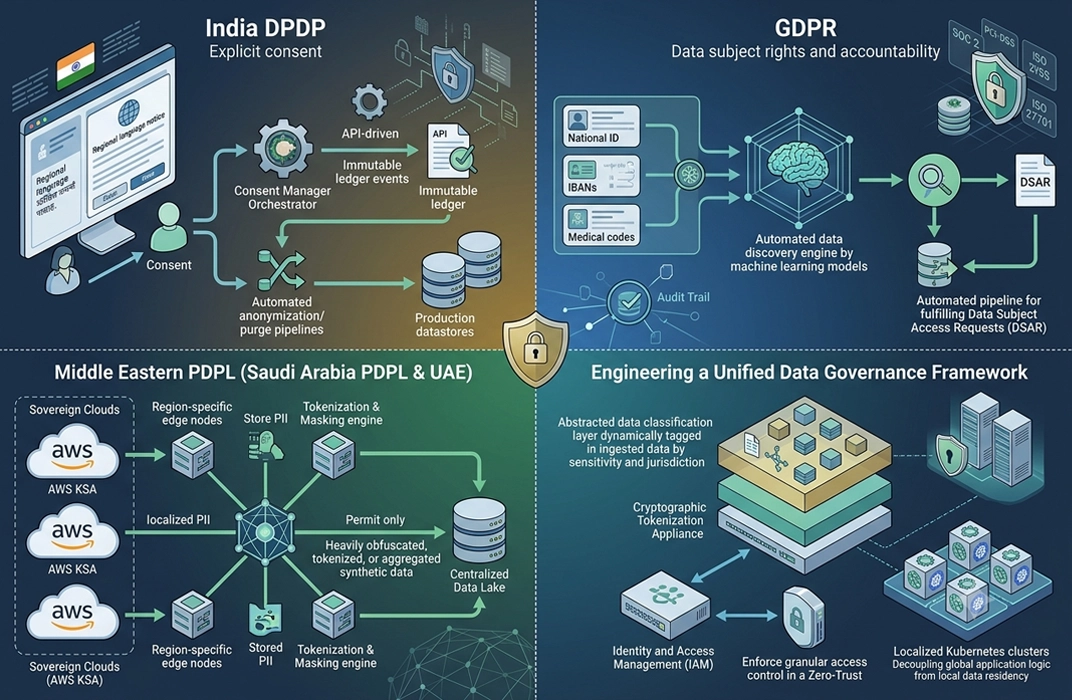
Managing global privacy mandates across competing regulatory frameworks requires CISOs to shift from fragmented, region-specific workflows to an unified data-governance architecture. This blueprint outlines how enterprise organizations can harmonize India’s DPDP, Europe’s GDPR, and the Middle East’s PDPL (Saudi Arabia and UAE) into a single, continuous compliance framework. By decoupling local localized data-residency orchestration from core cryptographic pipelines, security leaders can mitigate cross-border litigation risks, satisfy stringent AI Overviews (GEO) visibility criteria, and accelerate time-to-market for digital products.
Modern enterprise compliance is no longer a localized, annual audit exercise. For chief information security officers (CISOs) steering organizations across the Indian subcontinent, Europe, and the Middle East, data privacy has evolved into a complex matrix of overlapping, sometimes contradictory legal mandates. Relying on isolated, reactive security tools to pass regional audits creates operational silos, drives up engineering overhead, and introduces critical blind spots in your risk posture.
The real challenge lies in the rapid operationalization of three major regulatory pillars:
To survive this regulatory convergence, enterprise infrastructure must evolve. CISOs must transition their security architecture from a reactive posture—scrambling to patch systems ahead of a scheduled audit—to a state of proactive, continuous compliance.
| Dimension | Reactive Security Posture | Proactive Continuous Compliance Architecture |
|---|---|---|
| Audit Philosophy | Point-in-time snapshot assessments (e.g., manual annual audits). | Automated, continuous control monitoring and real-time posture telemetry |
| Data Discovery | Static asset inventories compiled via spreadsheets and interview questionnaires. | Dynamic, automated ML-driven data classification at rest and in transit. |
| Architectural Focus | Perimeter defenses and perimeter-based access controls. | Zero-Trust architecture integrated with granular, data-centric policy engines. |
| Regulatory Strategy | Siloed pipelines customized for individual laws (GDPR vs. DPDP vs. PDPL). | Unified abstract data-governance layer with localized edge-routing modules. |
| Incident Management | Ad-hoc forensic discovery following a confirmed data breach. | Automated, playbook-driven orchestration with baked-in compliance logging |
To build an adaptable compliance model, security teams must understand the core friction points among these three major regulatory frameworks. This requires looking past the legal text to examine how data ingestion, engineering pipelines, and storage architectures are affected.
Under the India DPDP Act, organizations act as “Data Fiduciaries” and must obtain consent that is free, specific, informed, unconditional, and unambiguous. This consent must be backed by a clear notice available in multiple regional languages.
The Middle East personal data protection laws (PDPL) present a distinct architectural challenge: strict data localization. Both Saudi Arabia’s KSA PDPL and the UAE’s federal data privacy law heavily restrict the transfer of personal data outside their national borders unless the destination country provides an equivalent level of protection, or the organization secures explicit regulatory approval.
[Local User Interaction]
│
▼
┌────────────────────────────────────────────────────────┐
│ Region-Specific Edge Node (Sovereign Cloud / KSA Edge) │
│ ────────────────────────────────────────────────────── │
│ – Local PII Storage (Encrypted at Rest) │
│ – Application of Local Tokenization / Masking Engine │
└────────────────────────────────────────────────────────┘
│
│ (Only Tokenized / Non-PII Synthetic Data)
▼
┌────────────────────────────────────────────────────────┐
│ Centralized Global Data Lake │
│ ────────────────────────────────────────────────────── │
│ – Core Analytical Processing │
│ – Global Threat Monitoring & SIEM │
└────────────────────────────────────────────────────────┘
The GDPR remains highly influential due to its sweeping extraterritorial reach and mature Data Subject Access Request (DSAR) ecosystem.
Harmonizing these rules requires building an abstract compliance layer directly into your enterprise software architecture. Rather than building separate workflows for DPDP, GDPR, and PDPL, you should design a core framework around the strictest requirements of each regulation, then apply localized policies at the edge.
Do not rely on your engineering teams to manually tag database columns for compliance. Implement an automated data discovery layer that hooks directly into your CI/CD pipelines and production environments.
Every ingested data element must be dynamically classified upon entry based on sensitivity and jurisdiction of origin. For example, a payload containing a European IP address and an Indian Aadhaar number must be tagged with multiple compliance policies simultaneously, dictating its retention period, encryption status, and authorized access pathways.
To maintain compliance while maximizing the utility of your global analytics platforms, implement cryptographic tokenization at the ingestion edge.
To keep your core product scalable, decouple your primary application logic from regional data residency requirements. This is achieved by utilizing microservices architectures running on top of localized Kubernetes clusters.
By containerizing your applications, you can deploy the identical application stack into an AWS region in Europe, an Azure zone in India, and a local sovereign cloud provider in the Middle East. Your global application orchestration remains uniform, while the data persistence layer remains strictly bound by local geography.
To transition your enterprise to a continuous, multi-jurisdictional compliance model, execute the following tactical playbook:
Deploy automated data mapping tools to trace the exact lineage of your sensitive data. Map out where it enters your ecosystem, which services process it, where it is stored, and who has access to it. Replace manual spreadsheets with real-time dynamic inventories.
Deploy a unified, policy-as-code engine (such as Open Policy Agent) across your microservices. Define your compliance constraints—such as data retention caps, cross-border transfer limitations, and encryption mandates—in code. This ensures changes can be audited, version-controlled, and instantly enforced globally.
Isolate high-risk compliance scopes (e.g., healthcare registries or banking cores) from the rest of your corporate network. Enforce micro-segmentation and require explicit mutual TLS (mTLS) authentication for all internal service-to-service communication.
Ensure every instance of PII access, consent modification, or cross-border data transfer triggers a tamper-proof log event. Forward these logs to a secure, write-once-read-many (WORM) storage bucket within your SIEM platform to streamline future compliance audits.
This blueprint is built on extensive operational experience managing data security inside highly regulated fields. Our frameworks align with globally recognized security standards, bridging the gap between high-level privacy legislation and technical implementation.
Our methodology integrates standard risk management protocols, including:
By anchoring your compliance program within these technical frameworks, your organization moves beyond basic regulatory checklists. Instead, you build a resilient, scalable infrastructure capable of adapting to new privacy mandates as they emerge.
Navigating the intersection of India DPDP, GDPR, and Middle Eastern PDPL requires more than generic legal advice—it demands clear, deliberate technical design.
Ready to de-risk your enterprise data pipelines? Book a Technical Architecture Review with our principal security architects. We will analyze your current data lineage, identify potential cross-border exposure points, and provide an actionable technical roadmap to build a resilient, continuous compliance architecture.
Any questions related to The CISO’s Blueprint for Multi-Jurisdictional Privacy: Harmonizing India DPDP, GDPR, and Middle Eastern PDPL?
Online | Privacy policy
WhatsApp us