




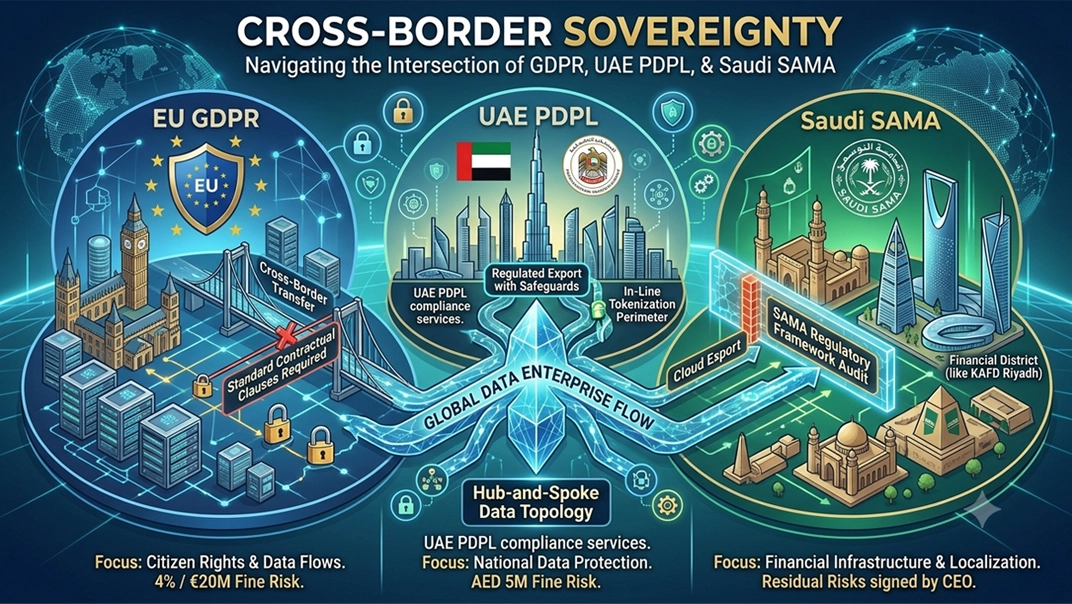
For enterprise technology leaders operating across the European Union and the Middle East, the regulatory landscape has evolved from localized compliance mandates into an aggressive, multi-jurisdictional enforcement model. Navigating data movement across borders requires balancing disparate frameworks that contain contrasting legal baselines and operating conditions.
When an organization handles data spanning the European Union (GDPR), the United Arab Emirates (UAE PDPL), and the Saudi Central Bank (SAMA Cyber Security Framework), standard compliance practices fall short. A failure in one jurisdiction can trigger systemic legal and financial vulnerabilities across your global infrastructure.
Developing cross-border data sovereignty requires identifying technical intersections, managing structural conflicts, and executing a unified data-engineering framework.
A unified posture begins by evaluating the core components of all three frameworks. While GDPR and UAE PDPL are broad data-privacy structures focused on citizen rights, the SAMA framework is a highly prescriptive, sector-specific security model engineered to protect critical financial infrastructure.
┌────────────────────────────────────────┐
                   │        Unified Data Ingestion          │
                   └───────────────────┬────────────────────┘
                                       │
         ┌─────────────────────────────┼─────────────────────────────┐
         ▼                             ▼                             ▼
┌──────────────────┐          ┌──────────────────┐          ┌──────────────────┐
│ EU GDPR Boundary │          │  UAE PDPL Scope  │          │ SAMA Regulation  │
├──────────────────┤          ├──────────────────┤          ├──────────────────┤
│ Right to Erasure │          │ 72-Hr Breach Log │          │ No Cloud Export  │
│ Max 4% / €20M    │          │ Max AED 5M Fine  │          │ Strict On-Prem   │
└──────────────────┘          └──────────────────┘          └──────────────────┘
Core Objective: Protect the personal data and privacy rights of EU residents, regulating data controllers and processors regardless of their physical location.
Key Enforcement Parameters: Strict requirements for a valid lawful basis (such as explicit consent or contractual necessity), automated data subject access requests (DSARs), and comprehensive cross-border transfer assessments. Non-compliance results in administrative fines reaching up to €20 million or 4% of global annual turnover, whichever is higher.
Core Objective: Establish a national data protection framework across the United Arab Emirates to secure personal and sensitive data.
Key Enforcement Parameters: Fully enforced, the UAE PDPL mirrors GDPR’s structure with localized adjustments, including a strict 72-hour breach notification window and mandatory Data Protection Officer (DPO) appointments for specific processing scales. The regulatory framework enforces a 30-day response window for data subject requests. Organizations leveraging UAE PDPL compliance services face fines up to AED 5 million for critical violations, including unauthorized cross-border transfers out of the UAE without adequate data-protection agreements.
Core Objective: Enforce strict cyber resilience, operational integrity, and data localization across Saudi Arabia’s financial, banking, and insurance sectors.
Key Enforcement Parameters: Unlike privacy laws, a SAMA Regulatory Framework Audit enforces strict operational rules. Residual risks cannot simply be accepted; they require explicit, signed justifications from the CEO. Financial institutions must undergo independent third-party audits and submit semi-annual cybersecurity reports directly to the central bank.
Managing this multi-framework environment reveals direct operational friction, particularly where cloud engineering and data architecture intersect.
Under the SAMA framework, financial transactions and core consumer records must remain localized within Saudi Arabia’s physical borders unless explicitly approved by the regulator. Conversely, GDPR and UAE PDPL permit cross-border data flows, provided the destination country maintains an adequate level of data protection or has standard contractual clauses (SCCs) in place.
The Technical Conflict: Running a unified global cloud architecture (such as a single AWS or Azure tenant) violates SAMA localization policies.
The Mitigation Strategy: Implement a multi-region tenant deployment. Restrict Saudi financial data to local cloud infrastructure nodes (e.g., AWS Middle East – Riyadh region). Use local database instances that communicate with global services exclusively via anonymized, event-driven APIs.
The UAE PDPL and GDPR mandate that a consumer can withdraw consent and demand data erasure at any time. However, the SAMA framework, alongside global AML (Anti-Money Laundering) and KYC (Know Your Customer) rules, requires financial transactions to be permanently preserved, immutable, and accessible for regulatory audit trail validation.
The Technical Conflict: A European or Emirati customer using a Middle Eastern financial application requests the “Right to Be Forgotten.” Deleting their record breaks the SAMA transactional audit requirement.
The Mitigation Strategy: Deploy data-segregation pipelines. When an erasure request arrives, strip out all direct personal identifiers (PII) from the customer profile to satisfy the privacy rules, but retain the pseudonymized transaction logs within your immutable, write-once-read-many (WORM) storage layer to preserve audit compliance.
To streamline your architecture across these frameworks without maintaining three disconnected security programs, implement this three-tiered roadmap.
Build a centralized identity and access management (IAM) perimeter that meets both privacy access rights and financial security requirements.
Implementation: Enforce phishing-resistant multi-factor authentication (MFA) across all administration portals and production clusters.
Framework Alignment: This technical control satisfies GDPR access limitations, UAE PDPL security mandates, and SAMA Domain 4.3 requirements for strictly controlled logical access barriers.
Automate your data-monitoring architecture so a single log repository satisfies multiple regulatory demands.
Implementation: Route all administrative changes, system access attempts, and configuration shifts to an isolated security account. Enable continuous data-integrity checks to prevent log tampering.
Framework Alignment: This infrastructure provides the precise forensic evidence needed for a SAMA Regulatory Framework Audit while simultaneously establishing the data-tracking baseline required to meet the UAE PDPL’s 72-hour breach reporting window.
Ensure sensitive information is automatically protected the moment it enters your storage environments.
Implementation: Deploy tokenization services at the API gateway layer. Mask sensitive personal data—such as national identification numbers, credit card details, and healthcare markers—before the data is written to disk.
Framework Alignment: Minimizing plain-text data storage reduces your risk exposure under GDPR and UAE PDPL, while fulfilling SAMA’s data protection mandates for critical information assets.
Sustaining compliance across the Middle East and Europe requires shifting from a reactive posture to a unified governance model. Technology teams must move away from isolated, framework-specific check-box tasks and focus on a single, hardened control framework.
By designing an adaptable architecture centered on localized database nodes, automated tokenization, and centralized identity validation, enterprise organizations can navigate shifting international data laws while keeping operational overhead low.
A compliant multi-cloud data architecture flow spanning Saudi Arabia and the UAE must reconcile two fundamentally different regulatory philosophies: Strict Sectoral Localization (Saudi SAMA) and Risk-Based Cross-Border Export with Safeguards (UAE PDPL).
To satisfy both without maintaining separate physical applications, you must deploy a Hub-and-Spoke Data Topology with an In-Line Tokenization Perimeter.
[UAE USER CONSUMER]                        [SAUDI ARABIA USER CONSUMER]
            │                                              │
            ▼                                              ▼
┌───────────────────────┐                      ┌───────────────────────┐
│  UAE Application Node │                      │  KSA Application Node │
│ (Azure / AWS UAE)     │                      │ (AWS Riyadh / OCI JED)│
└───────────┬───────────┘                      └───────────┬───────────┘
            │                                              │
            │ (Encrypted Clear Text)                       │ (Strictly Local Clear Text)
            ▼                                              ▼
┌───────────────────────┐                      ┌───────────────────────┐
│ Stateless Proxy &     │                      │ Dedicated KSA DB      │
│ In-Line Tokenization  │                      │ (Customer Managed Keys)│
└───────────┬───────────┘                      └───────────┬───────────┘
            │                                              │
            │ (Tokenized / Pseudonymized Only)             │ (Anonymized Analytics Only)
            ▼                                              ▼
┌──────────────────────────────────────────────────────────────────────┐
│                  GLOBAL CENTRAL WORKLOAD / CORE HUB                  │
│       (Aggregated Financial Reconciliation & Shared Services)        │
└──────────────────────────────────────────────────────────────────────┘
Regulatory Imperative: SAMA mandates that core transactional data, financial records, and operational logs must reside within the physical boundaries of the Kingdom. Residual risks cannot simply be accepted and must be heavily controlled.
Technical Flow:
Local Infrastructure Realization: Pin all active computing and storage for Saudi citizens to a localized cloud node (e.g., AWS Middle East – Riyadh Region).
Isolated Data Tiers: Databases containing plain-text regulated PII and financial ledger entries remain confined to local virtual private clouds (VPCs). No direct synchronization pipelines are permitted to export this clear-text data outside the country.
Cryptographic Control: Encrypt the local database utilizing Customer Managed Keys (CMKs) stored within a localized cloud Hardware Security Module (HSM). Ensure that the IAM policies governing the decryption keys restrict access strictly to identities operating within the KSA region.
Regulatory Imperative: The UAE PDPL permits cross-border data transfer provided the destination country has an adequate protection level, or if the organization implements approved safeguards like Standard Contractual Clauses (SCCs) or Binding Corporate Rules (BCRs) overseen by the UAE Data Office.
Technical Flow:
The In-Line Tokenization Perimeter: Run your front-end web application natively within a UAE cloud region (e.g., AWS UAE or Azure UAE). Before any user payload hits your central analytics or global processing hub, route the ingress traffic through a stateless proxy service.
Data Minimization & Tokenization: The proxy application intercepts the clear-text payload and splits the elements. Sensitive structural data (e.g., names, account numbers) are structurally replaced with mathematically un-linkable tokens (pseudonymization).
The UAE Secure Vault: The mapping table that pairs the original clear text with the token must remain securely written inside a database located strictly within the UAE geographic boundary. Only tokenized payloads cross out of the country to hit your global analytical clusters.
Technical Flow:
Aggregated Analytics: Your global or centralized core cloud environment receives two clean streams: fully tokenized, non-PII data from the UAE, and completely anonymized, aggregated financial ledger metrics from Saudi Arabia (conforming to SAMA data minimization rules).
Cross-Border Audit Trails: Centralized logging must be unidirectional. Application metrics, security groups, and identity logs from the spokes flow into an isolated, immutable Central Security Account utilizing WORM parameters (Write Once Read Many).
To satisfy regulatory inquiries, your infrastructure configuration must display the following mapping mapping to operational controls:
| Technical Control Component | Architectural Implementation | SAMA Framework Audit Proof | UAE PDPL Safeguard |
|---|---|---|---|
| Data Residency Boundary | Cloud tenancy boundaries restricted to AWS Riyadh or Oracle Jeddah. | System topology maps showing database physical volumes bound to KSA availability zones. | Isolates KSA compliance footprints from UAE jurisdictional systems. |
| Data Interception & Masking | Tokenization microservice proxy running via Kubernetes within UAE availability zones. | Proves zero unauthorized storage or cross-border leakage of foreign financial profiles into the Kingdom. | Fulfills data minimization principles; converts personal data to pseudonymized tokens before export. |
| Key Custody Separation | Segregated KMS key rings with location-enforced IAM policies. | Cryptographic verification that keys cannot be accessed or activated by accounts outside Saudi boundaries. | Establishes organizational and technical safeguards over clear-text decryption capabilities. |
Any questions related to Cross-Border Sovereignty: Navigating the Intersection of GDPR, UAE PDPL, and Saudi SAMA Frameworks?
Online | Privacy policy
WhatsApp us