




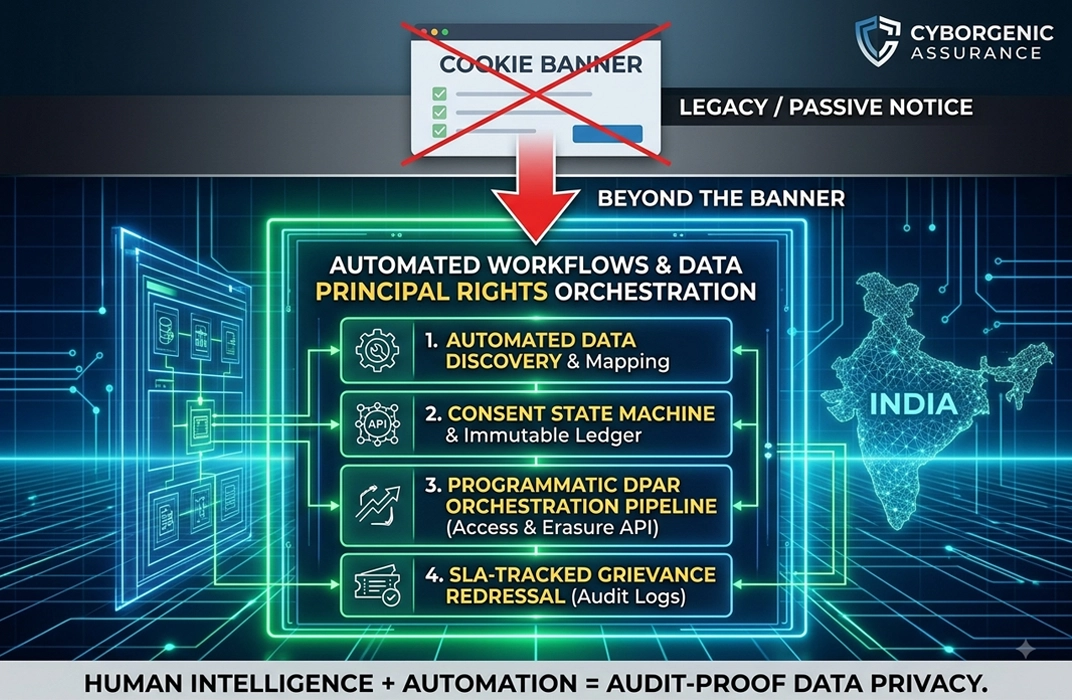
Superficial consent pop-ups and static privacy policies will fail to protect Indian enterprises under the Digital Personal Data Protection (DPDP) framework. With the Data Protection Board (DPB) operational and strict statutory timelines enforced, organizations must transition from passive notice-displaying to active, automated Data Principal Rights orchestration. This guide breaks down the technical architecture, database-level consent state propagation, and API-first grievance infrastructure required to build audit-proof compliance across legacy, microservice, and third-party SaaS environments.
For years, digital platforms operating across India treated privacy as a front-end cosmetic exercise. The standard operating procedure was simple: deploy an off-the-shelf Consent Management Platform (CMP), slap a cookie banner on the landing page, and hide vague processing terms deep within a 10-page Terms of Service agreement.
The Digital Personal Data Protection Act (DPDP Act) systematically dismantles this approach. Under Section 6 of the Act, consent must be free, specific, informed, unconditional, and unambiguous, expressed through a clear affirmative action. More critically, the Act explicitly outlaws “bundled consent”—the practice of making core service delivery conditional on agreeing to unrelated data collection (such as demanding access to a user’s contact book to deliver a simple food order).
┌────────────────────────────────────────────────────────────────────────┐
│                        THE FRONT-END ILLUSION                          │
│                                                                        │
│   [ User Clicks "Accept All" ] ──► Static Cookie Log Entry             │
│                                           │                            │
│                                           ▼                            │
│                             DB & Third-Party Analytics                 │
│                             (Data continues streaming)                 │
└────────────────────────────────────────────────────────────────────────┘
                                   VS
┌────────────────────────────────────────────────────────────────────────┐
│                      DPDP-COMPLIANT ARCHITECTURE                       │
│                                                                        │
│   [ Data Principal Action ]                                            │
│            │                                                           │
│            ▼                                                           │
│   ┌────────────────────────────────────────────────────────────────┐   │
│   │ Central Consent & Rights Engine (Immutable Ledger & Event Bus) │   │
│   └────────────────────────────────────────────────────────────────┘   │
│            │                             │                             │
│            ▼                             ▼                             ▼
│   [ Microservices API ]      [ Cloud Data Warehouse ]       [ SaaS Partners ]  │
│   (Immediate Cessation)      (PII Masked/Anonymized)        (Webhook Revoke)   │
└────────────────────────────────────────────────────────────────────────┘
The fundamental tension facing modern CISOs, CTOs, and Data Protection Officers (DPOs) lies in the operational execution of Data Principal Rights. When an individual revokes consent, requests a summary of their personal data, or exercises their right to erasure under Section 12, that request cannot sit in an unmonitored privacy@company.com inbox.
Without an automated, backend-orchestrated workflow, processing a single erasure or access request manually takes dozens of engineering hours across production databases, analytical data warehouses (e.g., Snowflake, BigQuery), backup tapes, and third-party SaaS vendors.
Missing statutory timelines or failing to enforce consent withdrawal across distributed systems exposes the enterprise to severe statutory liabilities—with statutory penalty limits scaling up to ₹250 crore for failures to enforce security safeguards and process rights appropriately.
To satisfy regulatory scrutiny, engineering teams must understand the exact technical capabilities required to move from passive notice display to programmatic enforcement.
| Operational Capability | Basic Front-End CMP (Legacy Approach) | Automated Backend Workflow Architecture (DPDP Compliant) |
|---|---|---|
| Legal Basis Validation | Captures a global true/false boolean flag in browser local storage or third-party cookies. | Maintains granular, purpose-linked itemized consent records mapped directly to unique Data Principal IDs. |
| Consent Revocation Propagation | Blocks front-end tracking scripts (e.g., Google Tag Manager) on subsequent page reloads. | Triggers async event-bus signals (Kafka/RabbitMQ) to halt processing across core microservices instantly. |
| Data Principal Access Requests (DPAR) | Generates static CSV dumps from primary MySQL/PostgreSQL databases manually. | Orchestrates automated API calls across relational databases, cold storage, and SaaS tools to compile an encrypted data package. |
| Right to Erasure (Deletion) | Executes simple DELETE queries on main database tables, often breaking foreign key constraints or leaving analytical logs intact. | Cascades programmatic soft-deletes/anonymization pipelines across cold storage, data lakes, backups, and vendor APIs. |
| Multi-Lingual Notice Synchronization | Displays automated translation on web overlays without backend state tracking. | Stores language preferences and exact notice versions presented at time of consent in an immutable audit ledger. |
| Nomination Rights Handling | Non-existent; relies on manual post-mortem legal submissions. | Provides dedicated UI workflows allowing principals to designate nominees for capacity/death scenarios. |
Building an audit-proof compliance infrastructure requires treating privacy as a core system capability rather than a bolt-on feature.
  [ STEP 1: Data Discovery ]  ──►  [ STEP 2: Consent State Machine ]
                                                 │
                                                 ▼
  [ STEP 4: Grievance Escalation ] ◄── [ STEP 3: DPAR Orchestration Engine ]
You cannot operationalize rights over data you cannot locate. Modern enterprises store Digital Personal Data across production databases, unstructured cloud buckets (AWS S3), messaging queues, and third-party CRMs.
Deploy Runtime API Discovery: Scan incoming and outgoing API traffic to discover shadow endpoints and unmapped PII data flows automatically.
Construct a Unified Identity Graph: Map disparate identifiers (phone numbers, email hashes, device IDs, account numbers) to a single internal DataPrincipal_UUID. This ensures an access or deletion request targeted at one identifier cascades across all associated profile records.
When a Data Principal revokes consent for a specific purpose (e.g., marketing profiling while retaining core service delivery), that state change must immediately propagate across your infrastructure.
Implement an Immutable Consent Ledger: Store consent logs containing the precise timestamp, notice version ID, itemized purposes accepted, and selected language.
Publish Real-Time Webhook & Event Signals: When a revocation event occurs, publish a CONSENT_REVOKED message to your central event bus (Apache Kafka/AWS EventBridge). Subscribing microservices (e.g., email dispatchers, ML feature stores) must consume this event and instantly cease processing.
For organizations seeking hands-on strategic assistance in aligning complex software architectures with regulatory frameworks, engaging experienced specialists for India DPDP compliance ensures your system architecture is fully mapped, audited, and optimized against evolving enforcement mandates.
Fulfilling Section 11 (Right to Access) and Section 12 (Right to Erasure/Correction) requests within statutory timelines requires automated workflow orchestration.
  [ Principal Initiates Deletion ]
                │
                ▼
  ┌─────────────────────────────────────────────────────────────┐
  │ Verification Layer (2FA / OTP / Identity Validation)       │
  └─────────────────────────────────────────────────────────────┘
                │
                ▼
  ┌─────────────────────────────────────────────────────────────┐
  │ Orchestration Engine: Check Statutory Retention Overrides   │
  │ (e.g., Tax, Anti-Money Laundering, Prevention of Fraud)    │
  └─────────────────────────────────────────────────────────────┘
                │
        ┌───────┴───────────────────────┐
        ▼                               ▼
  [ Blocked: Retain for Law ]   [ Clear: Trigger Deletion ]
                                        │
                                        ▼
                         ┌──────────────────────────────┐
                         │ Event Bus Cascades:          │
                         │ - DB Anonymization          │
                         │ - S3 Bucket Lifecycle Mask   │
                         │ - SaaS Vendor Webhooks       │
                         └──────────────────────────────┘
API-First Request Ingestion: Build self-service portals directly within your customer account dashboard where users can trigger access, correction, or deletion requests.
Automate Identity Verification: Authenticate the individual making the request via multi-factor authentication (MFA) or mobile OTP before exposing sensitive data exports.
Conditional Erasure Logic: Configure the orchestration engine to apply statutory exemptions. If tax or financial regulations mandate holding transaction logs for a set period, the pipeline automatically retains necessary financial records while scrubbing non-essential marketing and behavioral telemetry.
Integrating robust validation pipelines is critical. Many enterprises pair their privacy automation efforts with comprehensive Digital Personal Data Protection Act consulting to properly isolate legal retention requirements from operational data scrubbing routines.
Under the DPDP framework, Data Principals must have access to a clear, accessible grievance redressal mechanism. Failing to resolve grievances within published internal timelines allows individuals to escalate complaints directly to the Data Protection Board.
Automated Ticketing System: Route privacy complaints automatically to designated Grievance Officers or DPOs, complete with automated SLA timers.
Audit-Ready Logging: Maintain tamper-evident logs tracking when a grievance was logged, internal communications, actions taken, and final resolution dispatches to prove compliance in the event of a DPB inquiry.
The era of handling data protection through static documentation and cosmetic website banners is over. Under India’s DPDP Act, compliance is defined by runtime data visibility, automated consent state propagation, and robust API orchestration.
Organizations that embed privacy controls directly into their core software architecture will not only eliminate severe regulatory exposure but also reduce operational overhead and build lasting digital trust with their users. Treat Data Principal Rights not as a legal obstacle, but as an engineering requirement for modern enterprise resilience.
Any questions related to Architecting Data Principal Rights Under India’s DPDP Act: Beyond Cookie Banners to Automated Workflows?
Online | Privacy policy
WhatsApp us