
PCI DSS SAQD
Who Should Go for PCI DSS SAQ D?
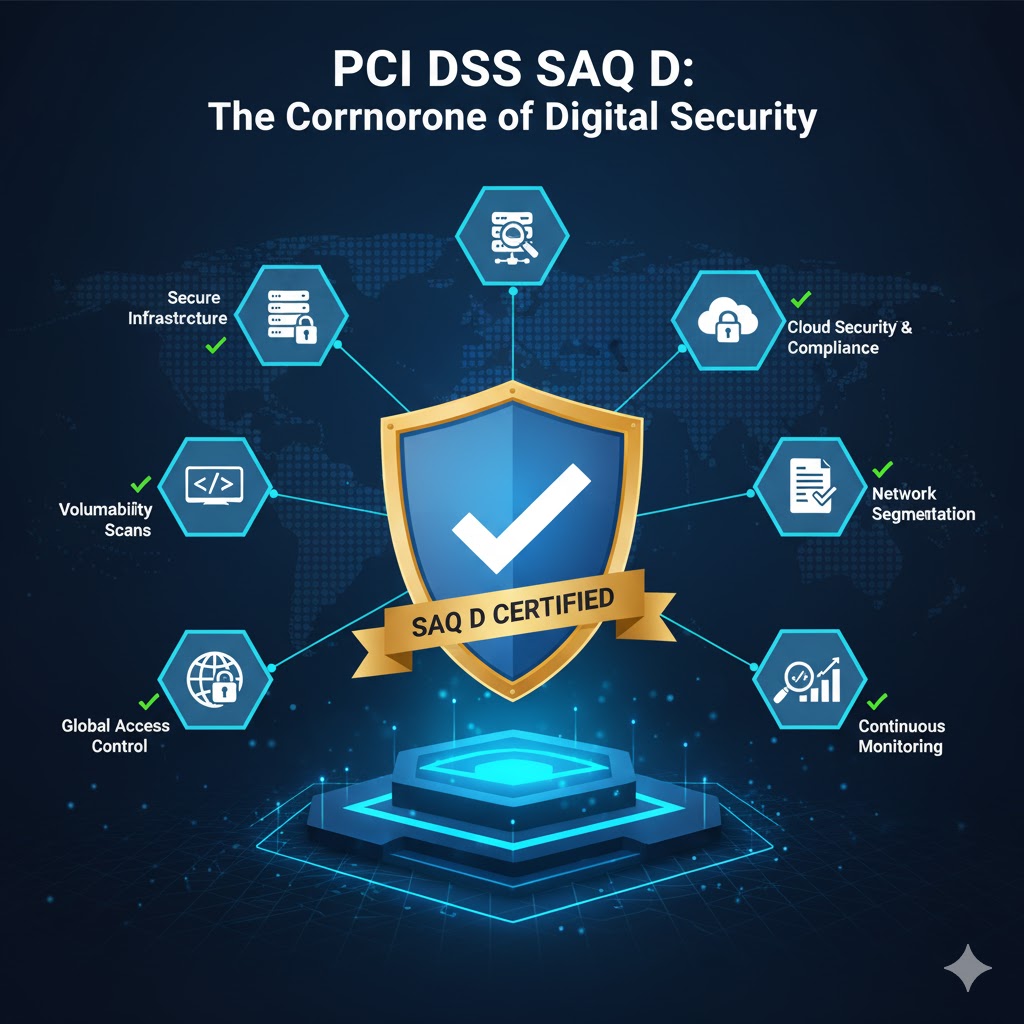
SAQ D is intended for organizations whose cardholder data environment (CDE) does not fit the streamlined scenarios outlined for other SAQs. You typically must use SAQ D if your business falls into any of the following categories:
For Merchants:
- You store cardholder data electronically (even if you don’t think you do, it’s important to verify).
- Your processing systems are connected to the internet and you do not use a PCI-validated Point-to-Point Encryption (P2PE) solution.
- Your payment environment is complex or not fully outsourced. For example, you have a connected point-of-sale (POS) system where card data enters your network.
- You do not meet the eligibility criteria for any other SAQ. This makes SAQ D the “catch-all” questionnaire.
For Service Providers:
- Any service provider that stores, processes, or transmits cardholder data on behalf of another entity must use SAQ D. There is no other SAQ option for service providers.
Common Examples of SAQ D Eligible Entities:
- Retail stores with connected POS systems that aren’t using a validated P2PE solution.
- E-commerce merchants who redirect to a third-party payment processor but whose website connection (e.g., iframe or JavaScript) can impact the security of the payment session (if they don’t qualify for SAQ A-EP).
- Hospitality businesses (hotels, restaurants) with integrated payment and property management systems.
- Any business that has never undergone a formal scoping exercise and is unsure of their data flows.
Methodology & Processes for SAQ D
The methodology for completing SAQ D is rigorous and mirrors the process for a full Report on Compliance (ROC), albeit as a self-assessment.
- Scoping and Discovery
- This is the most critical first step. You must identify all system components, people, and processes that are involved in or connected to the cardholder data environment (CDE).
- This includes servers, networks, security systems, applications, and even physical locations.
- Key Principle: If a system component can “see” the CDE, it is in scope.
- Gap Analysis
- Compare your current security posture against all relevant requirements in SAQ D.
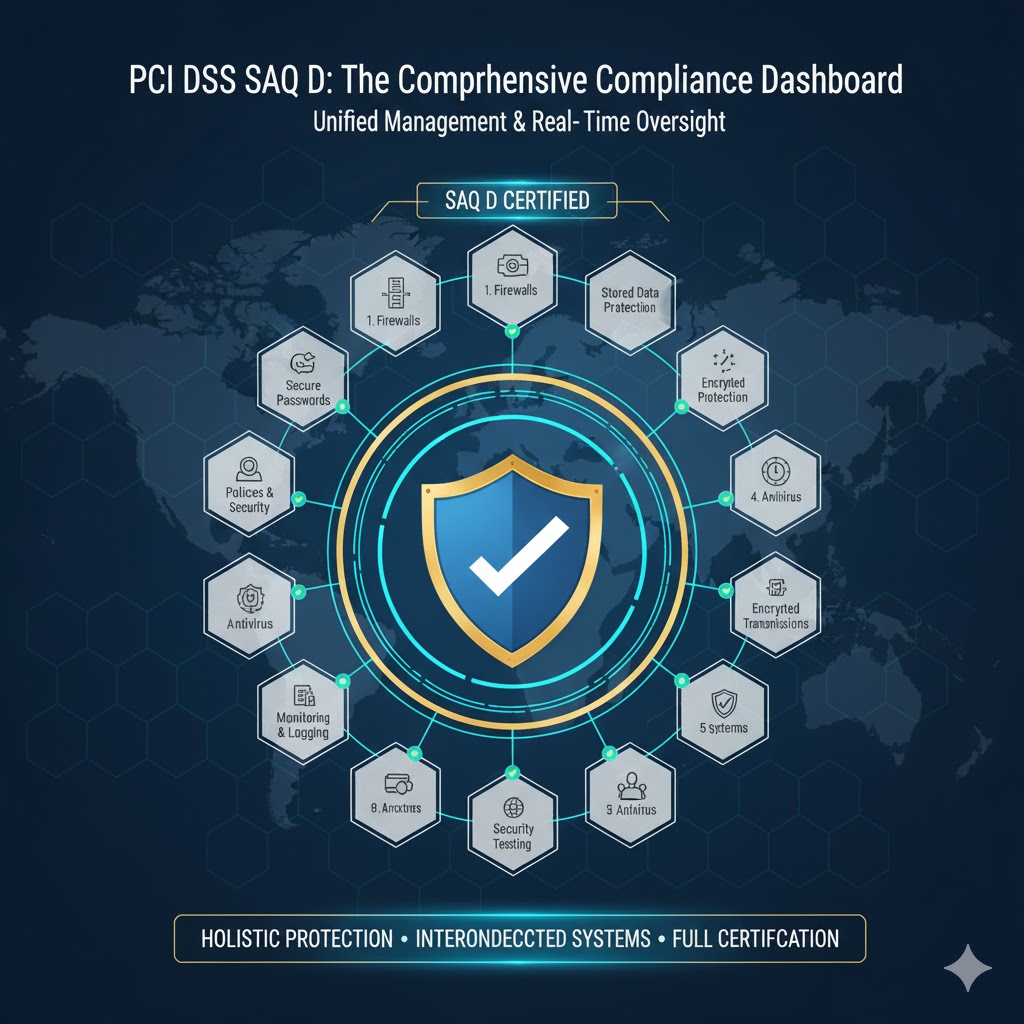
- SAQ D contains over 300 questions covering all 12 core PCI DSS requirements:
- Install and maintain network security controls.
- Apply secure configurations to all system components.
- Protect stored account data.
- Protect cardholder data with strong cryptography during transmission.
- Protect all systems and networks from malicious software.
- Develop and maintain secure systems and software.
- Restrict access to cardholder data by business need-to-know.
- Identify users and authenticate access to system components.
- Restrict physical access to cardholder data.
- Log and monitor all access to system components and cardholder data.
- Regularly test security systems and processes.
- Maintain a policy that addresses information security for all personnel.
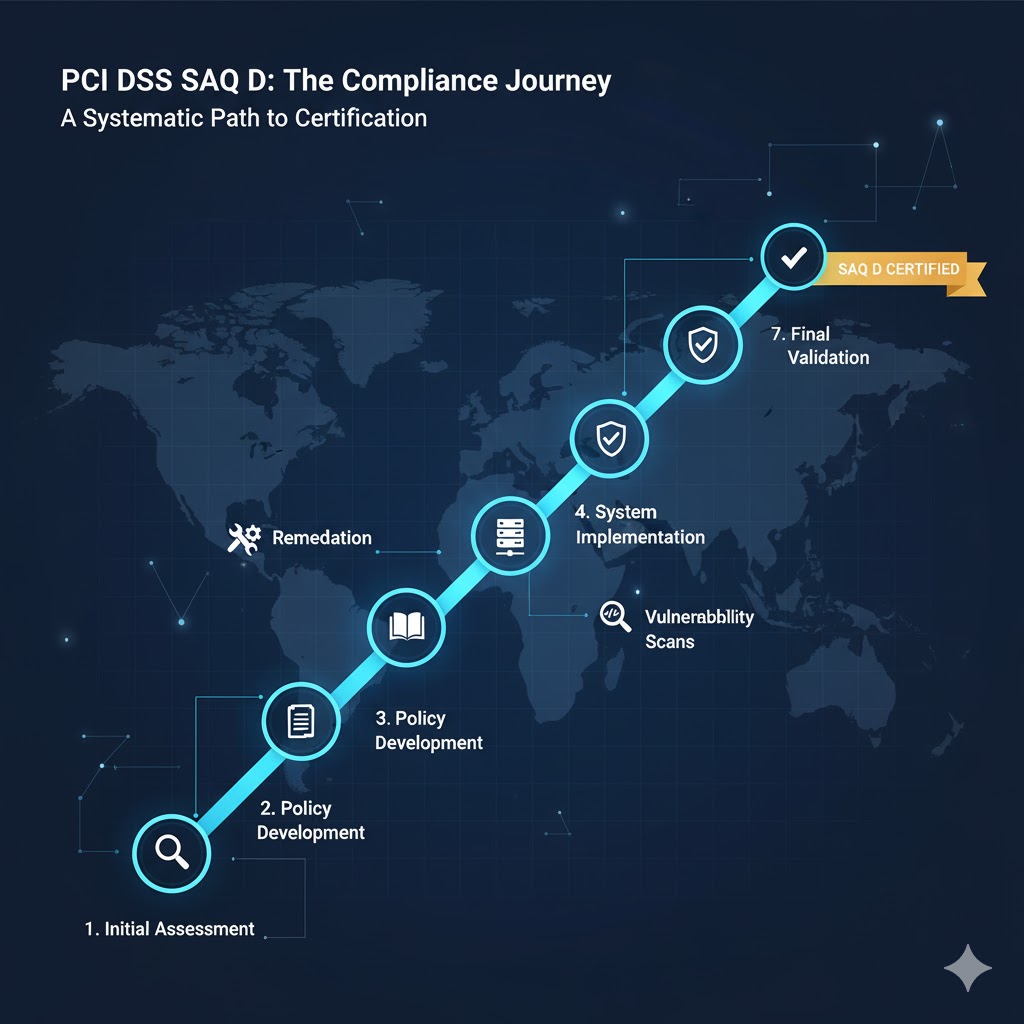
- Remediation
- Address all identified gaps from your analysis.
- This may involve implementing new technology (e.g., firewalls, encryption, logging systems), updating policies and procedures, and training staff.
- Compiling Evidence
- For every “Yes” answer in the SAQ, you must have documented evidence to prove compliance.
- Evidence can include:
- Network diagrams
- Policy documents
- Configuration screenshots
- Log files and reports from monitoring tools
- Results of vulnerability scans and penetration tests
- Training completion records
- Completing the Attestation of Compliance (AOC)
- The SAQ D form includes an AOC, which is a formal document you sign to declare your compliance status.
- You must select the correct AOC form (for Merchants or for Service Providers).
- Submitting the SAQ
- The completed SAQ and AOC are typically submitted to your acquiring bank (merchant bank) or payment brands, as required.
Timeframe to Complete the Process of PCI DSS SAQ D
The timeframe for completing SAQ D is highly variable and depends entirely on your organization’s starting point. It is not a quick process.
- For a Compliant Organization (Annual Re-certification):
- If you have maintained your security controls throughout the year, the process of evidence gathering and form completion can take 2 to 4 weeks.
- For a New Organization or One with Significant Gaps:
- This is a major project that can take 6 to 12 months or more.
- Breakdown:
- Scoping & Gap Analysis: 2-4 weeks
- Remediation (The longest phase): 3-9 months (involves purchasing tools, configuring systems, developing policies, etc.)
- Evidence Gathering & Final Validation: 2-4 weeks
- Form Completion & Submission: 1-2 weeks